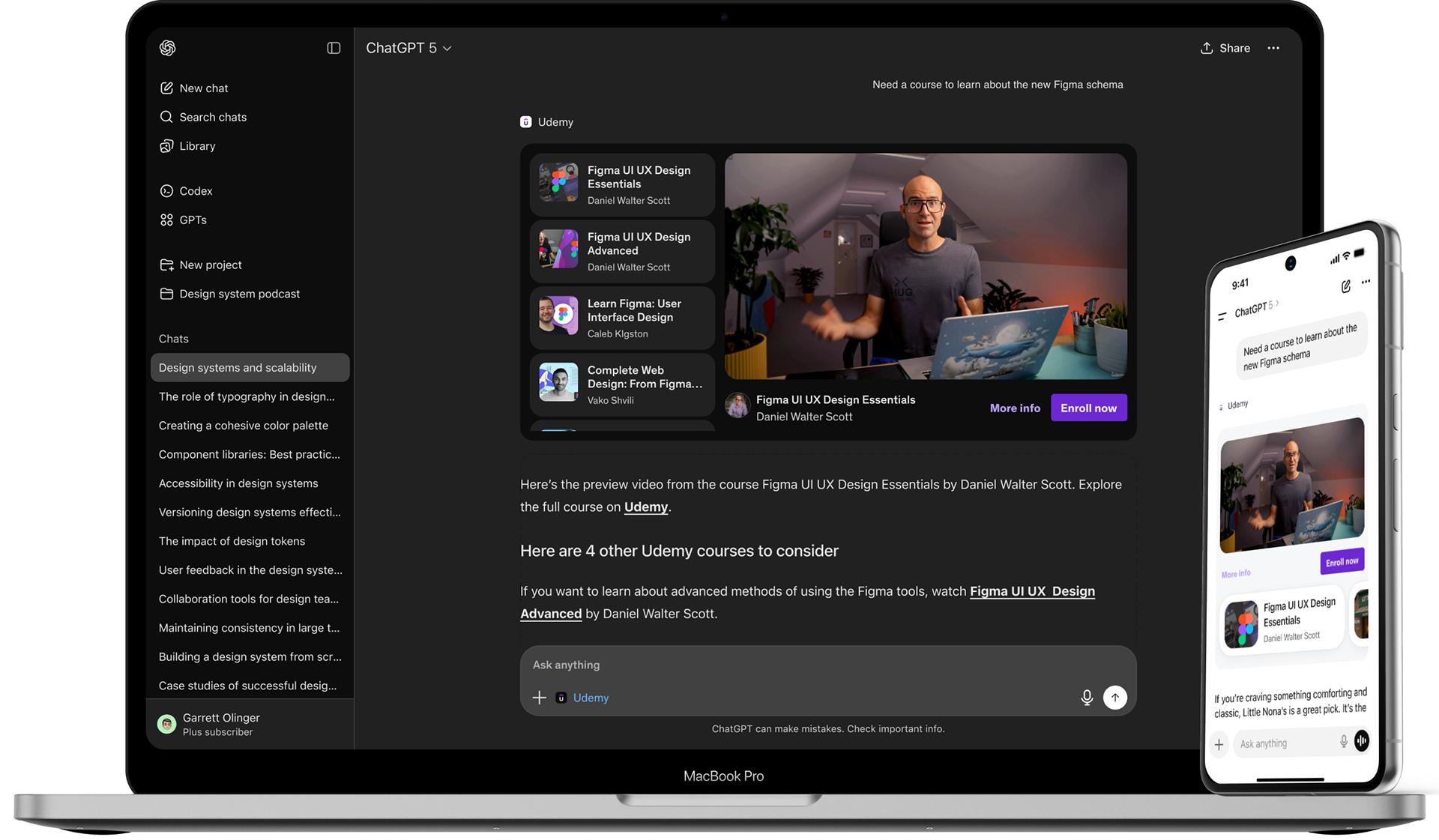
At a glance
Timeline: August 2025 – January 2026 (~5 months end-to-end; ~2 months active design)
Platform: ChatGPT app, built on the MCP iframe layout
Outcome (since Feb 2026 tracking): 170K visitors, 140K searches, 20K click-throughs to Udemy.com, 2,350 buyers, $110.5K GMV
The problem
Udemy has thousands of courses, but when someone asked ChatGPT or Claude what to learn next, Udemy had no presence in that conversation.
SEO-driven discovery is declining as users shift their intent-driven searches into LLM chats. MCP was the right integration layer because it lets Udemy's catalog become natively callable by any AI host, without building a separate integration for each one. My job was to figure out what the design layer of that integration actually looks like.
Discovery
I started by mapping the tool architecture, then grounded the UI decisions in Udemy's existing learner psychology research, since we had no time for primary research on chat surfaces specifically.
I worked from two sources of grounding: deep familiarity with Udemy's catalog and platform behavior, and direct exploration of ChatGPT's affordances and constraints as a host environment.
The catalog work was the more important of the two. Running a handful of representative queries against Udemy's own search made the density problem concrete: tens to hundreds of viable courses for nearly any topic, with ranking driven by signals (popularity, recency, instructor reputation) that don't always map to a given learner's needs. The implication was that any v1 of this product had to help users *vet* options, not just see them.
The ChatGPT exploration shaped the form factor. ChatGPT's MCP integration provides iframe-based layouts inside an otherwise conversational interface, meaning you can render real UI, but the user's mental model is still a conversation. That dual nature became the design constraint that organized everything else.